Intro to Java What is Java?
Learning objective: By the end of this lesson, students will be able to describe the role of Java in software development, some of its unique qualities as a language, and its significance in the software industry.
What is Java?
Java is a programming language that was first released in 1996. It was developed at Sun Microsystems by James Gosling. He created it after seeing teams struggle with using the C and C++ languages effectively and set out to solve the shortcomings he perceived with those languages. Those solutions became a few of Java’s headline features:
- Java code is highly portable. Developers can write Java code on any operating system or hardware architecture, which can be executed on any device using a Java virtual machine (JVM). This functionality inspired Java’s “write once, run anywhere” slogan.
- Java has automatic garbage collection, so developers don’t have to think about taking data out of a computer’s memory after they’re done working with it. Other techniques to help automatically manage computer memory are also used.
- Java is class-based and object-oriented from the ground up, not an optional added layer.
- Java supports multithreading at the language level to take advantage of modern hardware.
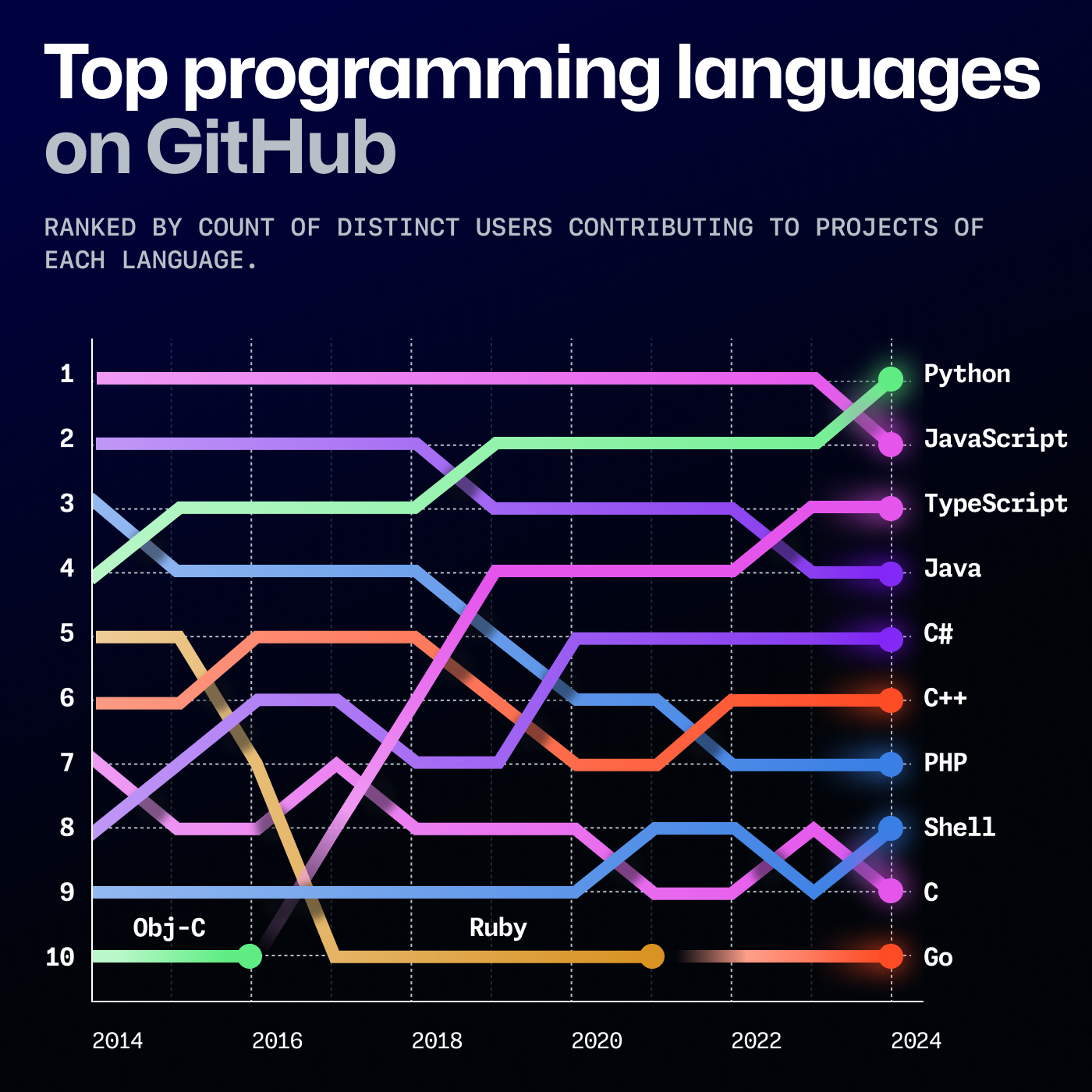
These features led to Java’s quick adoption and sustained popularity, especially in enterprise environments. GitHub’s Octoverse 2024 report shows Java as the fourth most popular language on GitHub.
Today, Java is maintained by Oracle after it acquired Sun, but the problems James originally intended to solve still drive the five core design goals of Java language:
- Simple, object-oriented, and familiar
- Robust and secure
- Architecture-neutral and portable
- High performance
- Interpreted, threaded, and dynamic
Duke
Java has an official mascot, Duke. Say hey, he doesn’t bite!